
Rarely is it the first mistake that results in an off or spin or crash. On average, I’d say that most crashes are the result of three mistakes.
A driver makes a small mistake, partly makes a correction, which leads to another relatively small error, and maybe another correction. But now the driver finds themselves in a very different place on the track (or the car unbalanced), and the next error is bigger and leads to a spin or off-track excursion.
If you make an error, fix it now. Don’t wait. If you do, things only get worse.
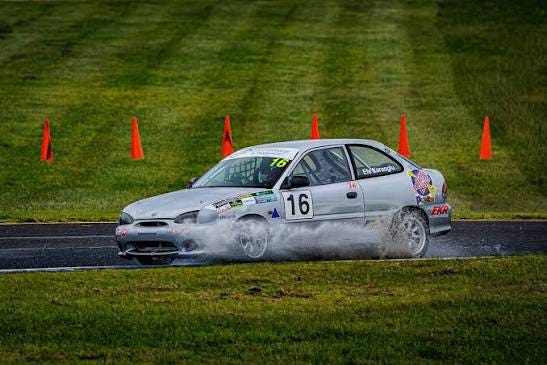
Let’s say that you’ve been hearing a lot of talk about trail braking lately, so you think you should put some emphasis on it during your next session. Assuming you haven’t mixed up breaking trail (driving off the track and through the trees!) with trail braking (any time that you have even a hint of your foot—left or right—applying any amount of pressure on the brake pedal for anywhere from an inch after turning into a corner to all the way to somewhere around the apex) you head into a tight right-hander up ahead after a relatively long straightaway.
You’ve been using the “3” marker on the side of the track as a reference to begin braking (BoB), but you didn’t factor in that you’d gotten a better-than-average exit out of the previous corner—and even a bit of a draft off of another car—so you’re now heading into the brake zone five MPH faster than ever before.
Mistake #1 is initiating your braking based solely on the Begin of Braking reference (instead of off the End of Braking), and now you find yourself arriving at the corner faster than ever before.
A mistake like this seems like a small one, and you’re right. But multiple mistakes add up. The goal is to not add to the list of mistakes—by adapting immediately. If you make a mistake, no matter how small, make adjustments right away.
As you get to the corner with more speed than usual, you’re getting really uncomfortable (possibly even experiencing some fear, or at least triggering your self-preservation mode). Human instinct kicks in, and you tighten your grip on the wheel and hold your breath, both leading to less feeling of the limits of the tires (right when you need this the most). Mistake #2 made.
Because you began to brake at the same place as usual, even though you were traveling faster, you arrive at the turn-in with more speed. Again, assuming you’re human, you do what humans do: you brake more (hard and longer). But you’re also turning into the corner, so you’re asking the front tires to do a lot, both brake and turn at the same time. And their response is to say, “Uh, no way, you’re asking too much of us. So, you know what we’re going to do? We’re going to give up and just slide instead of turning your car for you.”
Now you’ve got the front of the car plowing wide of the line you wanted to take, understeering because you were braking too hard while turning into the corner. Mistake #3.
As you run wide of your intended line, those instincts make you turn the steering wheel even more, trying to force the car towards the apex. Darn those silly human instincts! Instead of turning more, you slide off the track.
With your steering cranked to the right, your left-front tire digs into the grassy dirt, and you find yourself spinning as the rear slides in the grass. Mistake #4, because as you go off track with the front wheels turned so sharply, things could have gotten even worse with your car hinting at rolling over. Luckily, it didn’t.
With things feeling completely out of your control, fortunately the end is near, and you finally come to a stop.
Phew!
Later, back in the paddock, you replay the incident, hoping to learn something that will ensure that what happened will never happen again. What comes to mind are the moments entering the corner, and what you did with the steering. You wonder why, despite turning the steering more, the car didn’t respond (until you’d scrubbed off some speed and the left-front dug into the dirt on the outside of the corner). You conclude that it must have been too much speed that caused the whole thing.
While it’s true that your excessive corner entry speed contributed to the off, that’s not the whole story. What really caused the off started much earlier, something that was not addressed right away.
Notice how little led to so much. And, it actually started with a good thing: a better exit out of the previous corner so that your top speed leading into this corner was better than ever before.
Let’s review the mistakes:
Note that none of this was trail braking’s fault. Yes, trail braking gets all sorts of blame and name-calling for a variety of things, but this is certainly not the time and place for it! In fact, trying new techniques and skills is a good thing, as is digging deep into what really caused a big mistake (usually, something you did two or three steps earlier).
What’s important is what you learn from your mistakes, right? That’s why I call them learning-takes. The thing about track driving, though, is that you can’t go back and fix them. You have to focus ahead and deal with what’s coming up, and if you don’t adapt to where you are after making even a minor mistake, things are only going to get worse.
It’s one thing to sit back and think when you’re in the paddock after a session, and consider a mistake you made on track. You’ll learn from it, vowing to never do that again. But it’s a whole other thing to know you’ve just made a mistake in the moment, and immediately adapt to it.
Of course, it’s easy for me, or anyone else, to tell you what to do after the fact. So, here’s what I’d like you to think about after reading this:
We all make mistakes. It’s how we respond to them that matters. One thing that separates the best drivers from the rest is how they handle mistakes. In fact, they’re better at making mistakes. In other words, they make mistakes, but minimize the effects of them by sensing them, and adjusting for them, sooner.
Accept that you will make mistakes, but minimize their impact by not turning one into many.
Turn “I got it, I got it, I got it… I don’t got it” into “I got it… what’s ahead?”