
Last weekend I competed in a ChampCar endurance race at VIR, driving a well-prepped Miata in an 8-hour race on Saturday, and then a 4-hour on Sunday. (It was supposed to be a 7-hour, but the weather had a different idea, with fog delaying the start by three hours). Along with my co-drivers, Christian Maloof and Martin Duffy, we had the extra fun/challenge of testing new tires: BFGoodrich g-Force Rival +.
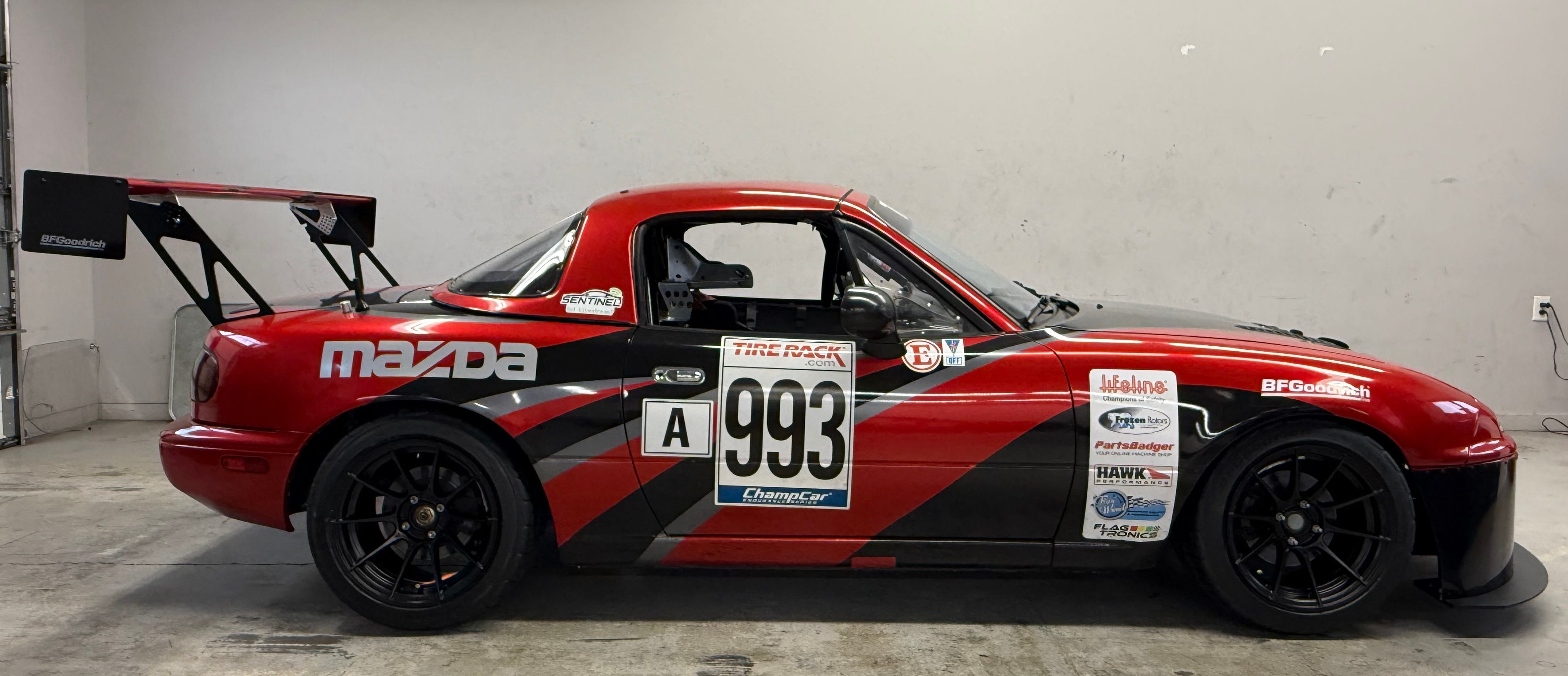
I’d heard a lot about these tires from my co-driver during the One Lap of America, Ed Gliss, back in May of this year. Ed had been a tire test/development driver at Michelin (who owns BFG) for many years before recently moving into a role that is focused more on spec-ing tire design to suit the market. In the week I spent during One Lap with him (over 4000 miles, 6 tracks, one autocross, and two skid pads; and spending part of a day at Michelin’s Proving Grounds in South Carolina), I learned a ton about what goes into tire design and development.
I’ve spent the past four-plus decades driving on what seems like thousands of different tire brands and types, from bias-ply on my first Formula Ford to Indy car radials, and DOT road-approved “race” tires to all-season tires never meant to be stressed on a race track. I’ve driven on so many different tires that I have to admit that my little brain is not capable of remembering every brand name/type, so when someone asks me what I think of the “BlackRubber Grippy-Plus-11” tire, I often shrug and go “Yeah, I think it’s pretty good. I don’t remember the details, but it didn’t do anything evil.” Or, “Yeah, all I can remember is that I didn’t like it because of the lack of blah, blah, blah.”
Yes, I should have been taking notes all those years… but I didn’t do that. Oops.
I’d also heard that the Rival + tires had gotten a really good rating in Grassroots Motorsports tire comparison tests, so we felt good about the switch from the tire the team had used in the past. But nothing really matters other than real-world experience.
At the end of the day, what matters to me is how a tire feels. Yes, I want the ultimate lap time out of every tire I drive on when on track, but there are other things I want (and sometimes even more than outright grip):
Of course, there are many more subtle and not-so-subtle factors that make a great tire, but these are the key ones for me. And, ultimately, what all of this comes down to is how fast can I consistently drive without feeling that any tiny mistake is going to result in an incident that is more than tiny.
My first laps on the Rival + were actually on the single pace lap (the Friday test day had been cancelled due to a bit of snow!), and I had not driven this Miata since the 2024 VIR race, one year earlier. And did I mention that it was cold? So, how quickly would the grip level be there? How much grip would I have diving into Turn One on the first lap? Was braking grip similar to cornering grip (some tires generate more or less longitudinal traction than lateral grip)? If I had some brake lockup, or the car slid, how easy would it be to correct? Would the grip level degrade over time?
Due to the way the grid was set (no qualifying), I started in 67th place overall and 16th in class, passed about six cars on the first lap, and eventually got up to 1st in class and in the top six overall. So, I knew the grip was pretty darn good! But how driveable were they?
I learned that about half a dozen laps into the race when a car I was passing in the Oak Tree turn did something I wasn’t completely expecting. A slight brake lockup, and a less-than-ideal quick downshift to second gear (my fault) resulted in the rear stepping out dramatically, but it was easy to catch, and I’m pretty sure I didn’t lose more than a tenth or two.
The further I got into the race (and with a very rare situation with just a couple of cars to pass in a lap), the more I focused on how the car/tires turned in. As you know, I’m a fanatic about the timing and rate of—and smoothness of—the brake release entering corners, so I played with this. VIR Turn 1 and 4 were the main places where I experimented to see how the tires responded. There was a side of me that was slightly disappointed that I didn’t have to be near-perfect with the brake release to get the car to do what I wanted. Sure, the better I was, the better they reacted, but if I didn’t quite get it right, it wasn’t like the tires punished me for it. They seemed be forgiving and predictable.
Then I focused on audible feedback to continue to “read” the tires. Our little Miata is not quiet, but it’s also not the loudest car I’ve ever driven, and there were times when I could sample grip by the sound from the tires. I first really noticed it coming down the Roller Coaster and in through Hog Pen, but then I started to use the sound in Turns 1, 3, 10 and 11 to help me sense the limit. There was a note that the tires made that aligned with what I was feeling about the maximum lateral grip; if it was not there, I knew to either release the brake a little quicker, or pick up the throttle—at least, add some maintenance throttle in there to ensure I wasn’t losing min speed.
Oh, and there was no doubt when there was a touch of brake lockup because the tire gave off a “nice” scream. Even if I asked too much of the tires—mostly the fronts as the car had a bit of understeer in the slower corners (needs a setup change)—there was a higher pitch from them, telling me to open up the steering.
It was really fun to communicate with the tires so much throughout the weekend, and being more focused on testing and learning the tires probably helped me be consistently faster throughout the event. Despite years of coaching drivers to focus on their own performance and let the lap times and result come to them, as a competitive person (understatement), I too need reminders (triggers) to stay focused on what’s important throughout four hours of racing—and listening and feeling the tires did just that. They helped me stay as consistent as their grip level, which was surprisingly even.
Afterward, I shared feedback with Christian Maloof (who is a very fast and smart racer), and we were completely aligned on takeaways from the tires.
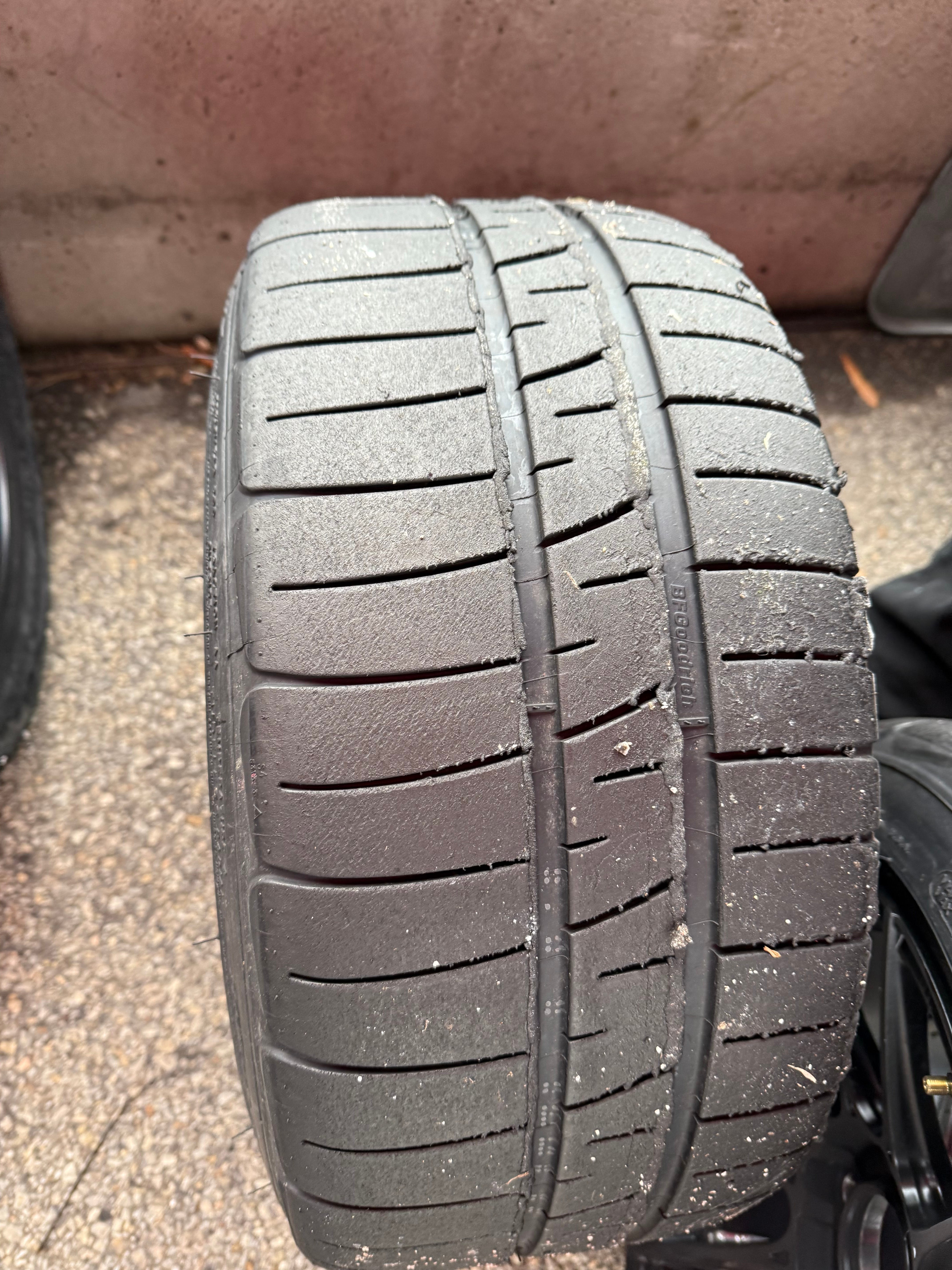
As with any budget racing event and team, a tire is no good if you have to go through many sets over the course of an event. While we had cold temps throughout the VIR weekend (did I mention that it was really cold?!), we all agreed that one set of the Rival + tires would last a full 8-hour plus 7-hour race event (fairly typical race events of ChampCar, Lucky Dog, WRL, etc.)
Oh yeah—we finished 2nd in class on Saturday (after a 6-minute pit stop to repair some damage when a co-driver got hit when lapping a slower car), and then 1st in class and 4th overall on Sunday. And it might be April before we all warm up after a very cold weekend (added to Sunday’s fog)!
I had a blast, and learned to be a better tire test driver (I’m writing this partly because it’s a good way of keeping notes!). Racing with No Foo Racing has always been fun because the people in it are awesome (thanks Arnie, Chris, Martin, Trish, Valerie, Christian, Mike, Joe, Chuck!), the car is prepped well, and we’re competitive.
One last comment: Years ago, I did a ChampCar (then ChumpCar) race at Road Atlanta for fun with some friends, and came away from it not feeling a big need to go back again. The level of driving and apparent car prep (which is a safety question), did not impress me. But in 2024 when Christian and the No Foo team asked me to drive a ChampCar race with them, it changed my mind. The level of driving and cars had risen, and it was fun. Okay, this past weekend I thought there were a couple of drivers who should have had more experience and/or training before racing at a track like VIR (a fast, challenging circuit!), but overall, it was great fun.
I wrote something about “You’ll never win without a great understanding of how tires work.” This past weekend, I learned more and gained more understanding of how tires work.