
I began instructing drivers on the track way back in 1980. Forty-six years of instructing will change how you think about almost everything.
One of my big Aha! moments caused me to often say, “Drive the car, not the track.” I’ve said this because many, many drivers get too caught up in “driving the line,” to the point of not being anywhere near driving their cars to the limit (or close to it). In other words, they’ve focused on the cornering line so much that it’s like they’ve forgotten to focus on driving the car to its limit.
Through my own driving, and instructing and coaching thousands of drivers, I’ve learned that if you drove at the limit, but your line was not ideal, you’d still be faster than a driver who was on the perfect line, but not at the car’s limits.
Of course, the ultimate goal is to drive at the limit, on the ideal line. The good thing is, if you drive at the limit, the car almost tells you where it should be positioned, and what line it should follow.
These thoughts, and many more (including the ones below), have been turning laps in my head for the past couple of months as I prepare for the upcoming Cornering Masterclass (go to SpeedSecrets.com for info).
Last week, here in Driving Directions, I wrote about references, and received a couple of interesting comments:
“This sentence is GOLD: ‘You can think of performance driving as a series of minor mistakes, with micro-corrections, where you’re constantly adjusting to where you are on track. The more you plan ahead, using references as your guide, the better you’ll drive.’ And not just for performance driving.” (Thanks David!)
“Ross Bentley practices what he preaches. He was right seat with me a while back, and he was consistently pointing out his references. All were ahead of us, and he would say “My reference for turn-in is that sign”, and so on. And then on one short straight he said, “That sign is my reference to look for my next reference, the orange end of that guardrail.” Yes, Ross has references for references!” (Thanks Bob!)
To repeat what I said last week, references are not all visual things. Sometimes you just feel a reference (bump, crest of a hill, compression in the track, nibbling at the curbing with your tires, etc.), or hear it (the engine sound reflecting off a guardrail or concrete wall, tire noise changing as the track surface changes, etc.). You see, feel and hear references… at least, you should.
And to emphasize what I wrote last week, references are something you “index” a driving action off of; and they’re not necessarily an individual point, but rather, a collection of things that provide you with a sight picture which triggers an action.
The key is that a reference, or group of references, trigger an action. But relying on references too much is almost as bad as not using them at all.
You know those connect-the-dots pictures designed for kids, where they draw a line from one point to another? When kids first experience one of these, the lines between 1 and 2, and then 2 and 3, and then 3 and 4… are straight lines. Eventually, the young artist looks and thinks ahead, and begins making arcs from one number to another because they have a target ahead of them (maybe even seeing the whole picture before they start drawing). When this happens, the drawing is much more realistic-looking, as it’s smoother.
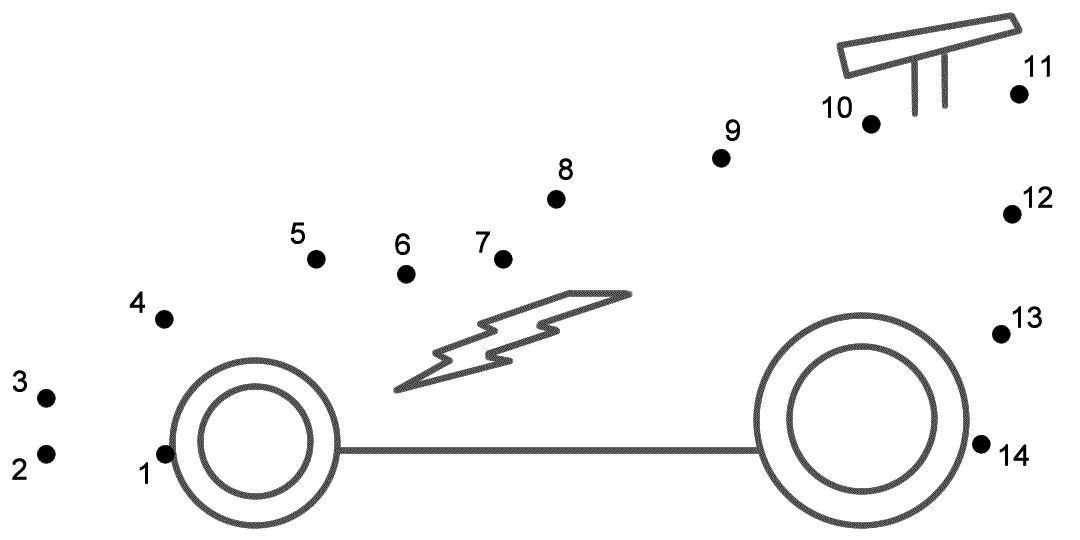
What these drawings really teach kids is to look and think ahead. Hmmm… maybe we drivers should spend more time with connect-the-dots drawings! Oh wait, we can do the same thing with a track map, and then apply it to our driving.
Many performance/race driving schools place cones at the key references (Turn-in, Apex, Exit) to help guide drivers. While this is a good way to start, too many event organizers leave these cones up on the edges of tracks for far too long, and many drivers never truly understand why these references are where they are. This has been proved to me: when the cones are removed, I see drivers struggling to find their way around the track. It also shows up when an experienced track day driver (one who has years of non-competitive track driving) is relatively “lost” in a multi-class endurance race where they have to adapt their lines as they’re passing and being passed.
Yes, reference cones do help drivers who are new to track driving get the idea of where to be positioned, but they can also rely on them too much. When that happens, it reinforces the habit of not looking and thinking far enough ahead; drivers become “lazy” and drive sequentially through corners, like connecting the dots of a drawing.
To be the best driver you can be, you need to understand why you drive the line that you drive, and how to adapt it when cars and conditions change. Interestingly, it starts with the end in mind.
A few years ago, after spending almost two years researching and thinking about how the best drivers use their vision, I had a conversation with Dr. David Ferguson who runs the Spartan Lab at the Michigan State University. In his lab, which focuses on many areas of race driver performance, he discovered something in the way that different drivers, of differing levels of ability, used their vision. The main take-away was that the very best drivers tend to focus, mentally and physically with their vision, on the exit of corners, even when they’re approaching a turn. From there, they worked back towards the beginning of the corner, and then did what it took to get to the exit.
So, instead of driving corners using references sequentially, they drove the corner with the end in mind, as if they were scribing lines on a connect-the-dots drawing. These drivers saw the big picture, and drove smoother — and faster.
This process begins with vision, and it’s the “process” (as I explain in the Vision Techniques Playbook) that makes the difference, beginning with what I call “Mental Vision” — the act of imagining what you can’t physically see. (Also refer to the Using Your Mental Vision post, and Glance & Focus Your Way Around the Track post).
As you approach a corner where the exit cannot physically be seen prior to the Turn-in point, you should have a strong mental image of where the exit is, and what it looks like. How do you get this strong mental image? From the previous laps you’ve turned, from mental imagery/visualization, and even from watching videos and driving a simulator. Really, you’re building a memory of where you want to go, and how to get there.
In the past, I’ve said races are won on the straights, and that’s still true. But, short of just having more power than everyone else, it’s what you do with the corners that maximizes the straight bits and gives you an advantage. So, maybe races are won in the corners? Oh wait, it’s the corners and the straights that matter the most!
Whether you race wheel-to-wheel, or participate in non-competitive track events, I’m pretty sure that it’s the corners that keep you coming back for more. Yes, at times it’s fun to see what your top speed is on straightaways, but ultimately, it’s the thrill, enjoyment, and challenge that come from the corners that we all love the most.
Identifying and driving the ideal line—one that leads to the fastest lap time—is a mixture of comparing radius to distance; using the elevation and camber, as well as track surface changes to your advantage; trading off speed in the right places to benefit speed in other places; using references to trigger the right actions; having a mental image of where you’re going before you can actually see it; and taking advantage of your car’s strengths and minimizing its weaknesses.
Wow, that’s a lot, isn’t it? And without a deep understanding of the key principles of cornering, and knowing why you should drive a corner in a certain way, you’ll have to rely on someone telling you where the line is (which may be slightly different in your car, at a certain moment in time).
It’s the understanding and ability to adapt—because you know why you’re doing what you’re doing—that makes our sport so rewarding and fun.